

When Germany launched the DiGA Fast Track in 2020, the healthtech community was hyped: Founders were promised comprehensive reimbursement for digital therapeutics (DTx) across Germany and in a unified pathway.
A few years later, many early investors and founders got burned. By today, most VCs are treating DiGAs as a no-go area. The challenges have become obvious:
Adoption and upside seemed limited - Even the best DiGAs barely broke €5–7m in annual revenue, with prices limited to a standard ~220€/quarter.
Scaling wasn’t cost-efficient, at least for VC standards. DiGAs required large teams and costly sales partnerships to grow.
Upfront costs were brutal due to clinical evidence, data infrastructure and compliance. Think €4m+ before meaningful sales.
The fallout were insolvencies like recently Perfood and Cara Care, retraction of launches, and an overall chilling effect on early-stage DTx in Europe.
Enter: The DiGA 2024 Report
Last week, the annual DiGA report 2024 was released. It tracks prescriptions across market participants. Their headline: Despite all challenges, the numbers of DiGAs had grown to 59 listed products, of which 38 permanent.
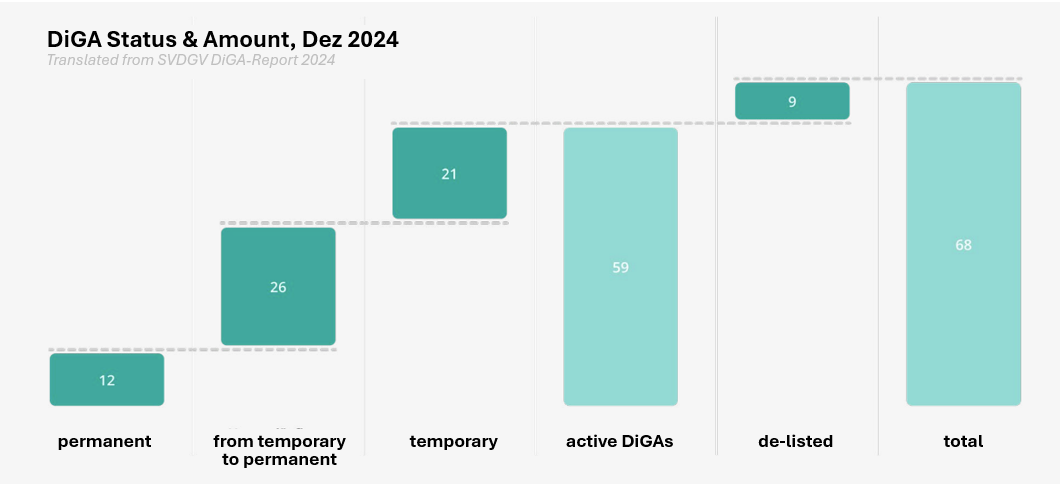
Many were quick to conclude a “great and continuing success story for DiGAs”, since overall prescriptions had skyrocketed to over 500k between October 2023 to December 2024, more than 2x the previous period.
Is that all?
I sat down with DTx expert Jonas Albert, partner at fbeta, to dig deeper. He works with pharma and founders and constantly tracks market developments. Here’s what we discussed:
Is Oviva changing the DTx narrative?
When dissecting the 2024 DiGA numbers, a pattern emerges: The entire market growth seems to rely on one single actor, Oviva. They are one of the better-known obesity DTx providers.
Turns out, Oviva scaled their DiGA adoption by 6.5x to 125k prescriptions last year. If you extrapolate by their price point, that equals over €27m revenue and shatters the historic glass ceiling of € ~7m annual revenue per DiGA.
How? Let’s look back at Oviva’s recent marketing strategy, which caused an uproar in the community.
The critical piece: They systematically faxed doctors, nudging them to prescribe. Some were annoyed - but it worked.
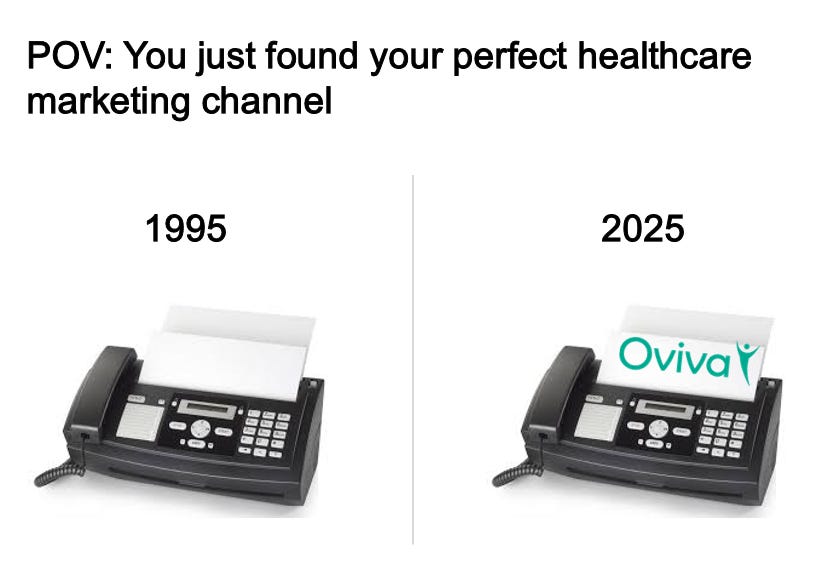
To be clear, Oviva and others use a mix of marketing strategies (see also this excellent article from Dominik at perfood). They used TV ads, doctor network activation, mailing, social media campaigns and more. Importantly, they profit from guideline inclusion and a well-tested product.
We can’t know the exact channel split, but it’s fair to assume contacting prescribers played or a functioning “prescriber brand” a crucial role: Over 73% of Oviva’s DiGA codes were prescribed by doctors vs triggered by patients themselves.
In Jonas’ opinion, Oviva nailed what most DiGAs haven’t: A functioning go-to-market engine. One that doctors actually respond to - even if it’s unclear today how scalable or efficient it can be in the long-term.
For the first time, investors are seeing DTx growth that looks like VC growth - somehow predictable, steep, and driven by systematic marketing.
The dark side…
Unfortunately, there’s a dark side to Oviva’s recent success. Last year, local providers were pressing charges against the company, claiming illegal marketing tactics (see their lawyer’s LinkedIn post).
They argue doctors had never agreed to being contacted and tampering with their professional freedom to choose an appropriate treatment. An initial court confirmed that assumption, but a final court decision is still pending. Markus Bergler, another DiGA veteran, is one of the most vocal critics of the sales tactic - I recommend his recent LinkedIn article.
Oviva argues it only amplifies the patients’ voice, who have a right to access impactful treatment options such as DiGAs. Anyways, I am no legal expert and will keep observing from the sidelines.
Beyond the legal debate, I do have questions from an investor’s perspective:
Is the fax strategy a lasting one? The short-term effect is impressive, but it seems unlikely it builds a positive brand image and creates repeat prescribers. To quote a founder in the field: “Doctors prescribe to avoid discussions, but they hate it.”
Will statutory insurers push back on tactics that ultimately threaten their budget stability?
Will copycats flood the new channels and render acquisition costs prohibitive? Rumour has it that Oviva’s marketing spend is immense (>10m?) already
We will have more clarity on unit economics once re-prescription rates are published. Oviva is btw rumoured to improve theirs significantly.
VC-biased conclusion: It’s good to see movement in the category after years of mediocre growth. Oviva has clearly pioneered a new approach, a sort of out-of-the-box thinking we need in healthtech.
Let’s guess market impact
On the one hand, it’s safe to assume other DiGA providers are debating copying the model or finding their own twist.
On the other hand, rising adoption has revitalized pharma interest in the space according to insiders. Some even call it sheer FOMO. Catalyzed by Medice’s recent acquisition of Selfapy, pharma is looking for a stable and tested digital market footprint. We might see further M&A this year.
I’m also curious if Oviva’s success triggers a new generation of market entrants with a more scalable go-to-market. Nonetheless, first-mover advantages seem to be strong between DiGAs so far.
When it comes to VC activity, I don’t believe the verdict on the market will change anytime soon. The core challenges (upfront costs, market ceiling, prohibitive CAC) remain and political and legal risk in an Oviva-like strategy remains prohibitively high.
Happy Monday,
Lucas