

Oura’s S-1 is out and I finally managed to take a look at it. Before you ask: It’s 92 documents, I have an actual job and my unpaid intern is still on vacation. So I can’t read every single word - instead I asked myself a very specific question: Now that they’re exiting, can we learn something from Oura’s equity story? Who’s going to make the most from their IPO?
Sure, we could wait for final IPO price and actual allocations. But where’s the fun in that? Via the S-1, we already have a public record of what happened in Oura’s past. We also have rumours of a targeted IPO valuation. Enough ingredients to do some back-of-the-napking math.
Let’s find out what happened to earlier vs later investors, and who sold too early.
The funding story, in a nutshell
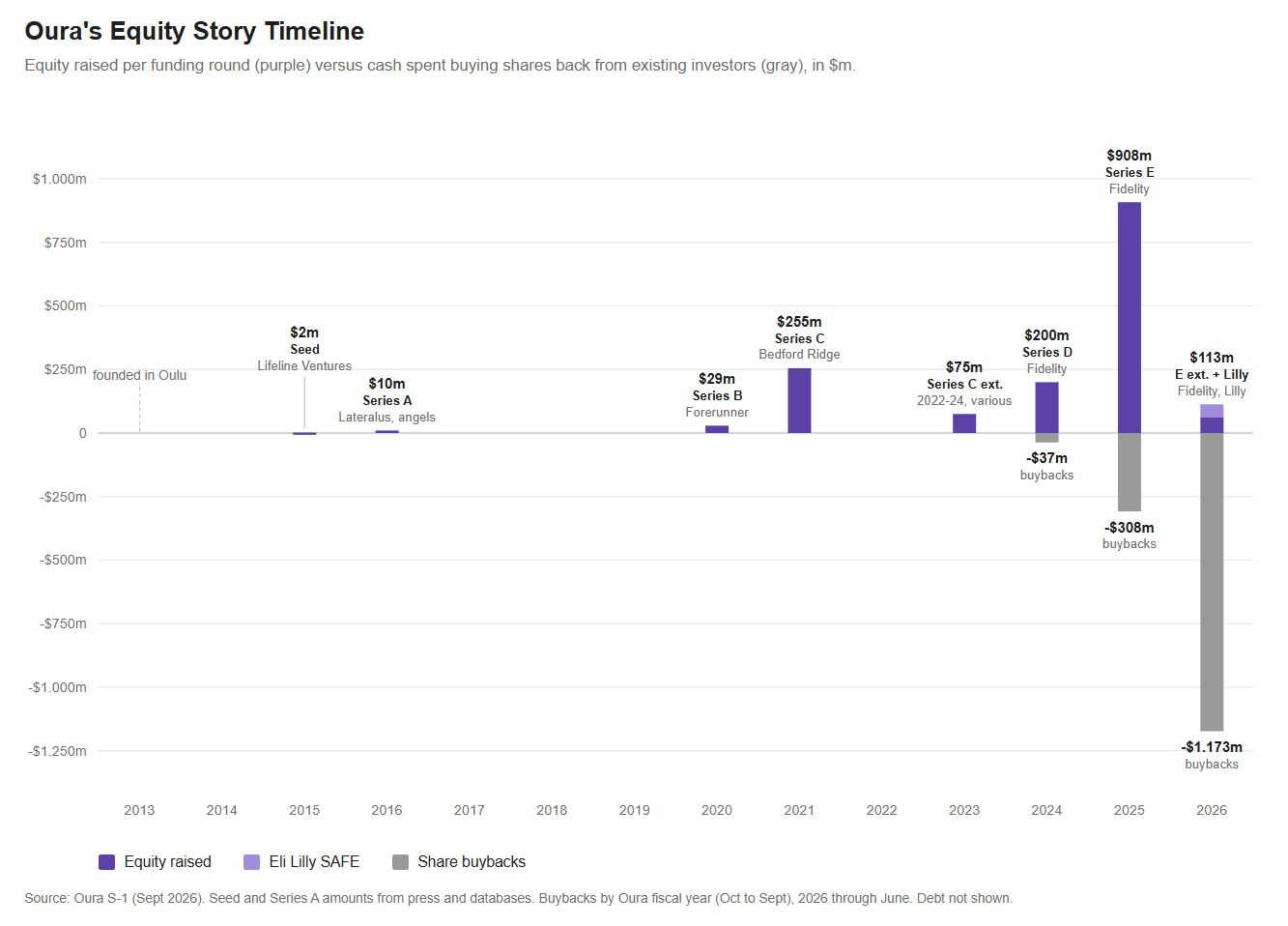
Oura started in Oulu, Finland, in 2013 and raised some first outside money via Kickstarter in 2015. That campaign “only” sold rings, it did not give out shares. There might have been angel investors, we don’t know that. First publicly documented institutional money was a ~$2m seed from Lifeline Ventures in 2015. Bold and excellent move in hindsight! Their Series A followed a year later, roughly $10m in capital.
It was only around 2020 that things truly started to accelerate. In 2020, they pulled a Series B from Forerunner ($29m), and a Series C in 2021 led by Bedford Ridge Capital (~$255m), later an extension of $75m.
From Sept 2024 to April 2026 it was constant back and forth. On one hand, Oura took in a Series D ($200m) and a Series E ($970m), both led by Fidelity. On the other hand, they conducted ~$1.5b of share buybacks. In the end, Oura paid back pretty much every dollar it ever took.
In other words: The Series D and E went straight into share buybacks, plus the debt Oura had taken on for the same purpose. The result was a “cleaned” cap table ready to go public. News pieces are now floating a $3b IPO raise at a $16b valuation.
The business underneath is solid btw. Oura makes well over $1.5b in annual revenue run rate, with a growing share coming from subscriptions. They have 5m paid members, low churn, and are profitable at core business level. Impressive.
Now that we’ve established the timeline, let’s move on to who will make money from this. I’d see 3 lessons here:
Lesson 1: At $16b, everyone is happy
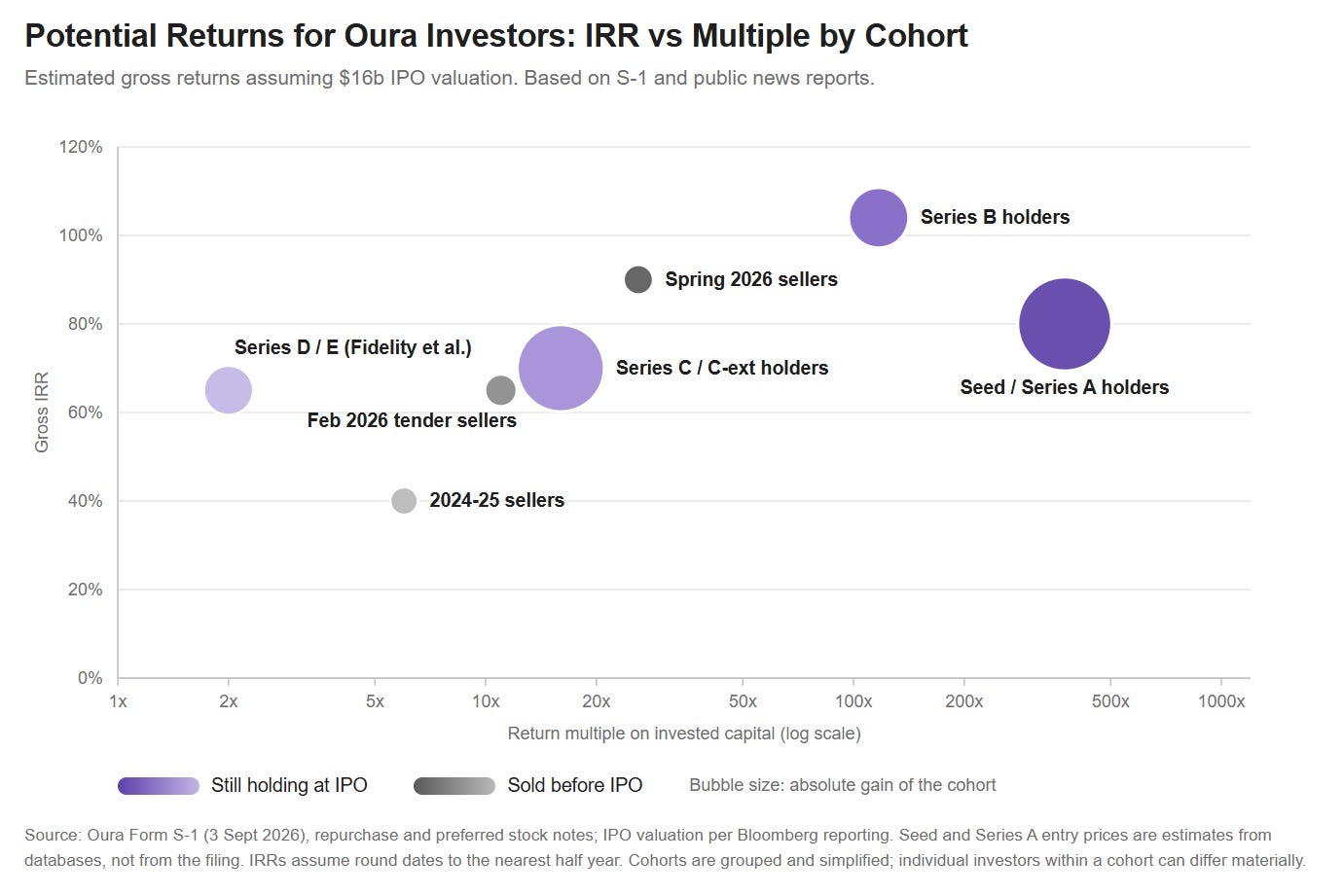
Based on the S-1 and public news pieces, I tried to reconstruct the investor cohorts and their most likely returns. Before we jump into them, I’ll be specific about what we know and where I had to guess:
We don’t know exact entry prices for investors in the earlier rounds, esp. Seed and Series A
I grouped and simplified some of the investor tranches, because the repurchases happened piece by piece, and it got confusing
The IPO price isn’t confirmed, and we don’t know at all whether everyone wants to and can sell at that price. To simplify, I pretended everyone would be able to sell at IPO
We also don’t know any liquidation preferences in the cap table, but if the IPO plays out as positive as expected, that’s not relevant
What we do know: The repurchase tables in the S-1 name the share classes that were already bought out (Seed vs A vs B etc.). They tell us both price and timing. One investor, Forerunner, is even named specifically, since they held over 5% at the time of the filing.
Here’s the resulting chart:
Learnings?
If the $16b becomes the exit price, cohorts that held until IPO could realize between 2x and roughly 400x. The early investors are obviously the largest winners by IRR and multiple: Lifeline and other early believers sit at the 300-400x end of that range.
The one return we can state with certainty is Forerunner’s early partial exit. They took ~$65m in Series B shares off the table in the February 2026 tender, at a ~$7b valuation. That means a respectable 52x multiple. And Forerunner still holds a good chunk in the company (at least 5% according to the S-1), which would be worth at least $660m at the target IPO valuation. For comparison, their active fund at the time of the Series B was most likely Fund IV with $360m in volume, so they’re looking at 1-2x their fund returned from this one position.
Overall outcome: Everybody wins, there’s no investor cohort that loses here.
Btw, the founders don’t appear in the filing. Not as officers, directors or >5% holders. I don’t wanna jump to conclusions... but it looks like they dropped out / were pushed out early on. They won’t profit from this amazing IPO story.
Also interesting: CEO Tom Hale (joined 2022) earned $600k base salary plus a $495k bonus in fiscal 2025, so roughly $1m in cash. On top he holds ~3.9m RSUs that vest at IPO. At the target valuation, that’s worth around $350m...
Lesson 2: Some people left billions on the table
Besides all gains, one element deserves attention: The huge share buybacks and investor buyouts over the past years. What happened? Did the sellers in these transactions sell too early and miss out on later gains? At the very least, prices went on a mysterious rollercoaster between transactions.
In concrete numbers:
In Sept 2024, $33m common shares were bought back at a ~$1.8b valuation, two months before the Series D at ~$5b
In fiscal 2025, Oura bought back a large block of shares at a ~$3.2b valuation, months before the Series E at ~$9.7b
In Sept 2025, another block was taken out via a bank structure, also at ~$3.2b, in the same month the Series E closed at 3x that
In Feb 2026 came the tender at ~$7.2b, about 25% below the Series E, while the IPO is now being floated at $16b
It’s easy to jump to conclusions and say that Oura tricked these shareholders into selling low... there’s even a pending lawsuit pointing in this direction: Harpreet Rai, CEO until Dec 2021, alleges he was misled into a Sept 2024 agreement to sell his shares back. Oura disputes the claims of course. Note: the S-1 does not say whether the $33m Sept 2024 buyback is his, but the timing matches.
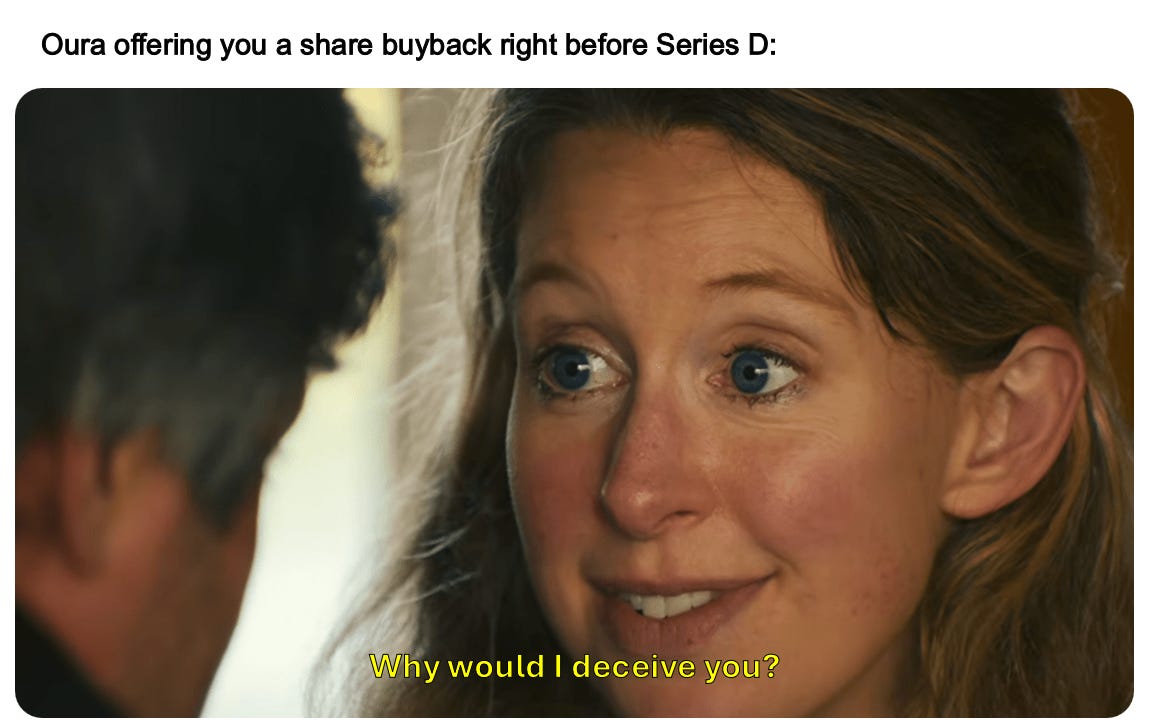
To be clear, it’s very normal that such secondary transactions come with a significant discount to the market price. The reason iThe 25% discount in 2026 for example seems more than appropriate, but earlier differences are rather steep. To put it in perspective: The numbers we know suggest ~$2.1b were left on the table by the 2024-2025 sellers, when comparing it against a $16b IPO.
One partial explanation for these buyouts are VC funds that needed liquidity. The repurchase tables show Seed and Series A shares among the sellers in 2025 and 2026, meaning some investors had held for 8-10 years and needed to close their funds. Would they have waited two more years if they knew we were talking about a $16b IPO? Perhaps, but it’s also good practice to take returns off the table.
Anyways, we’ll wait for the lawsuit to clarify the ex-CEO claims. What’s clear is that on four occasions, the company bought low shortly before it sold high. Clever moves - I should definitely try that for my private stock portfolio.
Lesson 3: It didn’t take that much capital
Besides amazing returns, Oura teaches us a lesson on capital efficiency. Think back to the 2010s: Investors used to shy away from hardware and consumer health companies at the time Oura was started.
And there are valid reasons! It can take tons of cash to bring such products to market. For classic medical hardware, let’s say a continuous glucose monitoring device, you can easily reach $100-200m just to develop, certify and launch...
Against this background, it’s impressive how capital efficient Oura was in their journey. Their strategy paid off:
They launched the ring as a wellness device (much cheaper, less regulated) with a few million in funding. They didn’t need hundreds of millions to prove demand
Up until the Series C extension they collected ~$360m equity plus a $130m term loan. Sounds much at first, but it got them to ~$500m revenue and 2m paid members. Super capital efficient
Now that the company dominates their niche and is profitable, they’re unlocking medical territory
And in case you’re asking “what about the rest of the money raised?!”: Remember, most of the capital after Series C wasn’t growth capital. It was $1.17b in from Series D and E, and the same amount in share buybacks over the following months. Not a reflection of the business capital needs.
Bottom line
If the IPO goes well, Oura is a pure-bred venture success story, no questions asked. Against many odds actually. It shows how you can:
Scale healthcare innovation from Europe (Finland is a ~6m people country) to the whole world and a $16b outcome

Get awesome returns in unpopular investment categories. Oura was consumer and hardware, while everyone was busy throwing money at B2B SaaS
Give companies time to scale and compound. Oura was 7 years old when they raised their Series B, and still grew their value over 10x after that

At the same time it’s a cautionary tale about selling too early, and it leaves some questions around what happened to the early founders.
From a European perspective, it’s a reminder that we should work on funding and exiting our companies right here. Lifeline is the one European name left on the cap table - almost everything after the Seed was priced and funded from the US.
Props to everyone involved, and I’m looking forward to the next generation of underdog European success stories!
Speak soon,
Lucas
Thanks for sharing! Great to see a European success story.
Fantastic read. Thanks for sharing.